

For Small Apartments Electric Bike: How to Choose, Store, and Ride One Without Losing Your Living Room
Living in a tiny apartment doesn’t mean giving up on two wheels. It just means the bike has to earn its floor space. Advice for small apartments electric bike shoppers usually starts with one question: where will this thing sleep at night? Get that answer right and everything else, from the motor to the lock, gets much easier.
This guide walks through what to look for, what to measure, and how to keep a bike (and its battery) safe in a home where every square foot counts.
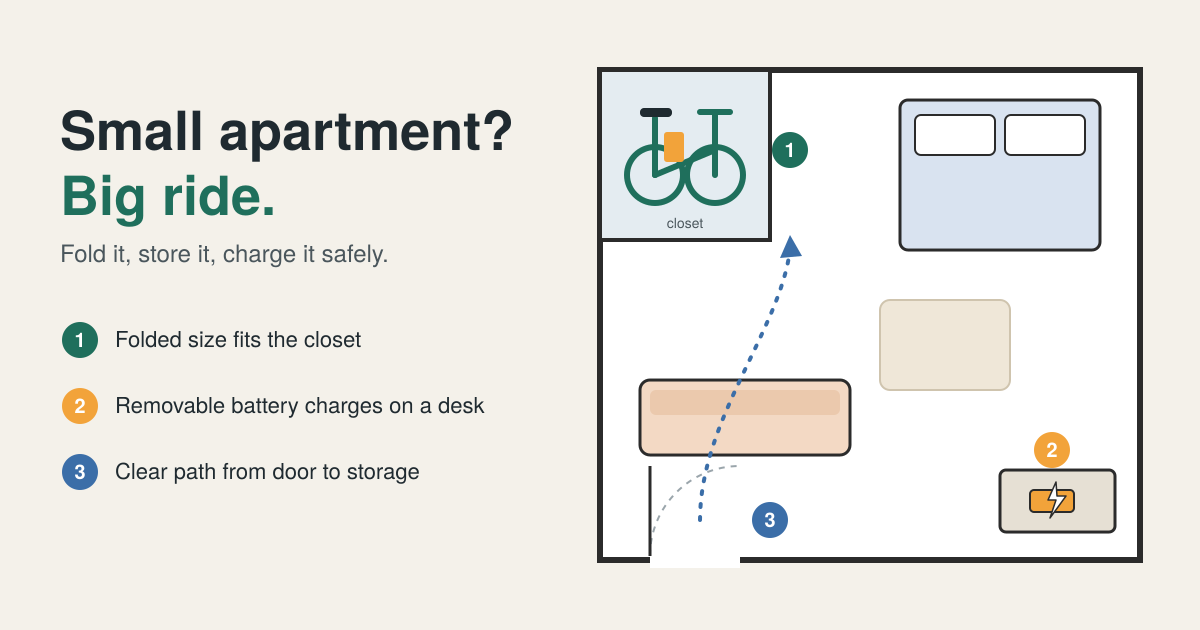
What Is a Compact Electric Bike?
A compact electric bike is a bike with a battery and motor that’s been designed to take up less room than a standard model. That might mean a shorter wheelbase, smaller wheels, a frame that folds in half, or a seat and handlebar that drop down or tuck away.
Many riders pick a folding electric bike because it shrinks to the size of a large suitcase. Others prefer a foldable e-bike with a simple hinge in the middle of the frame. Either way, the goal is the same: an electric bike for small spaces that you can park in a closet, not a garage.
Will Any E-Bike Work in an Apartment? Not Quite
It’s tempting to think any e-bike will do. In reality, a full-size cargo bike or a heavy fat-tire model can turn an apartment into an obstacle course. Those bikes can weigh 60 to 80 pounds, and they don’t fold, lean neatly, or hang on a wall.
An e-bike for apartment living needs to be easy to move, easy to tuck away, and safe to charge. A true apartment e-bike treats storage as a feature, not an afterthought, and a small apartment e-bike treats it as the first requirement.
What Makes an E-Bike Apartment-Friendly?
Three things matter most: weight, size, and how forgiving the bike is when you’re short on room.
Weight and Portability
If you live above the ground floor, weight is everything. A lightweight electric bike is far easier to wrestle through doorways and tight hallways. Many shoppers look for an e-bike under 50 lbs, since that’s a weight most people can lift with one arm for a short stretch. A lightweight frame made from aluminum alloy usually helps keep the numbers down.
A truly portable electric bike also balances well when you pick it up, which matters more than the number on the spec sheet.
Smart Folding Features
A quick-fold mechanism can save you a lot of daily frustration. If a bike is easy to fold, you’ll actually fold it. If it’s fiddly, it ends up leaning against your sofa. Look for a latch that locks firmly and doesn’t need tools.
A bike that’s easy to carry also tends to have a sensible grab point, like a top tube that sits comfortably on your shoulder or a seat post you can hold.
Frame and Fit
A step-through frame makes getting on and off easier, especially in tight entryways or when you’re wearing work clothes. An adjustable handlebar and adjustable seat let several people share the same bike, which is handy in a household with just one parking spot for it.
For Small Apartments Electric Bike: How to Choose
Here’s the part most buyers wish they’d read first. The best for small apartments electric bike how to choose approach is simple: match the bike to your home before you match it to your commute.
What Folded Dimensions Actually Fit Your Home?
Manufacturers love listing the unfolded length, but what counts is the folded size. Check the folded dimensions against your closet, the space under your bed, or the gap behind your front door. Remember to account for pedals, handlebars, and the seat post, since those often stick out past the main frame.
A good rule: add two inches to every measurement for breathing room. A bike that fits “just barely” will scrape your walls every single day.
How Much Weight Can You Safely Carry?
Be honest here. A bike might be rated at 45 pounds, but that feels very different at the top of a fourth-floor walk-up. If you plan to carry an e-bike upstairs, try lifting something similar, like a loaded backpack, up the same stairs first. If it’s a struggle, look for a lighter model, or choose an elevator-friendly e-bike that rolls easily on its small wheels once folded.
Wheels, Motors, and Power
Small 20-inch wheels are common on compact bikes because they keep the frame short and the fold tight. They feel nimble in traffic, though they can be a bit bumpier on rough pavement.
For power, a hub motor is the usual choice on compact models because it’s simple and sits quietly in the wheel. Motors typically come in a few sizes:
- A 250W motor is gentle, efficient, and common in regions with strict e-bike rules.
- A 350W motor adds a little more punch for hills.
- A 500W motor handles steep climbs and heavier riders, though it often comes with a heavier bike and bigger battery.
Most riders will also enjoy pedal assist, which gives you a boost only when you pedal, so the bike feels natural and stretches the battery further.
Battery Capacity and Range
Battery size is measured in watt-hours, and it’s the best clue to how far you’ll go. Higher battery capacity generally means a longer range per charge, but also a heavier pack. For short city rides, a mid-sized pack is plenty. Always treat manufacturer range numbers as best-case estimates, since hills, wind, rider weight, and assist level all change the result.
A removable battery is a big win for apartment dwellers. You can take a portable battery inside to charge at a desk or countertop without hauling the entire bike up.
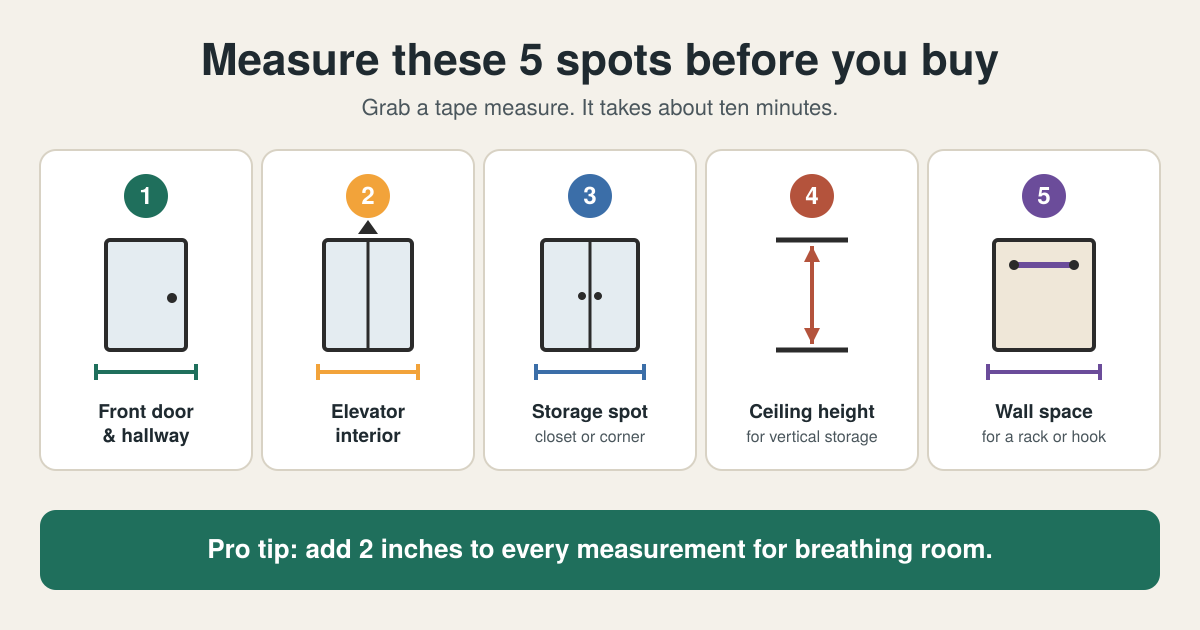
Map the Entire Route to the Parking Spot
Before buying, walk the full path your bike will take, from the street to its final resting place. Count the doors, the turns, the steps, and the elevators. Notice whether the lobby is narrow or the hallway has a sharp corner.
This simple test reveals more than any spec sheet. A bike that fits in your closet but can’t get through the lobby door isn’t a good match.
Measure at Least These Five Areas
Grab a tape measure and check these spots:
- The front door and hallway width, including any awkward corners.
- The elevator interior, if you have one.
- Your storage spot, whether it’s a corner, a closet, or under a desk.
- Ceiling height, if you plan to hang the bike vertically.
- The wall space where a rack or hook might go.
Write the numbers down and take them shopping with you. It takes ten minutes and can save you a return.
Why Small Bikes Make Sense for Apartment Life
A compact bike isn’t just about storage. It also fits how people actually live in cities. A city e-bike is quick off the line, easy to lock up, and simple to park. An urban e-bike can zip through traffic and handle short errands without a fuss.
Many riders use a commuter e-bike to skip crowded roads, and plenty of them pair it with the train. For a public transit commuter, a folding model is ideal, since it can ride onto the platform and fit under a seat. It also makes the last-mile commute from the station to the office faster and less sweaty.
Battery Safety and Charging Indoors
This is the part that deserves a little extra care. Lithium-ion batteries are safe when they’re well made and well treated, but poor-quality packs have caused real fires.
Already have an e-bike that needs a tune-up or a battery check? FutureEV offers electric bike repair, and the battery page explains how to look after a pack so it lasts longer.
Why Certification Matters
When it comes to e-bike battery safety, look for independent testing. A UL 2849 certified e-bike has had its entire electrical system checked, including the battery, charger, and motor working together. A UL 2271 battery has been tested on its own for things like overheating and short circuits. Some cities and buildings now ask for these certifications, so it’s smart to check before you buy.
Can You Charge an E-Bike in an Apartment?
Yes, in most cases, as long as you do it carefully. If you’ve ever wondered, “can you charge an e-bike in an apartment?”, the answer is that charging e-bike indoors is common, but a few habits help:
- Use only the charger that came with the bike.
- Charge on a hard, non-flammable surface, away from curtains, beds, and sofas.
- Don’t charge while you sleep or when you’re out of the house.
- Unplug once the battery is full.
- Never charge a battery that’s swollen, damaged, or hot.
How to Store an Electric Bike in an Apartment
Smart storage is what makes small-space riding feel easy. If you’re asking how to store an electric bike in an apartment, there are plenty of tidy options.
Apartment E-Bike Storage Ideas
Good apartment e-bike storage uses spaces you already have:
- Vertical bike storage stands the bike on its rear wheel against a wall, which saves floor space.
- A wall-mounted bike rack lifts it off the floor entirely. Check your bike’s weight before choosing one, and make sure it’s anchored into studs.
- A bike storage closet works well for folding models, especially if you can park it beside shoes and coats.
- Hallway storage can work if the bike folds flat and leans neatly against the wall.
A sturdy kickstand is also useful, since a bike that stands on its own is easier to live with than one that constantly slides down the wall.
Locks, Trackers, and Landlord Rules
Even if the bike lives inside at night, it’ll spend time locked outside during the day. A strong anti-theft lock is a must, ideally a hardened U-lock. Adding a small GPS tracker gives you a second layer of peace of mind and can help you locate the bike if the worst happens.
Before you buy, read your lease. A landlord e-bike policy might limit where you can store or charge a bike, or require specific certifications. A short conversation with your property manager now can prevent an awkward surprise later.
For Small Apartments Electric Bike Alternatives
An e-bike isn’t the only answer. If you’re still unsure, consider these for small apartments electric bike alternatives:
- A standard folding bike is lighter and cheaper, with no battery to worry about.
- An electric scooter takes even less room, though the ride is less comfortable on bumpy streets.
- A shared bike or scooter service skips storage completely, which works if you ride only occasionally.
- A conversion kit turns a regular bike into an electric one, but it takes more tools and know-how.
Each of these has trade-offs in comfort, range, and cost, so it helps to think about how often you’ll actually ride.
Budget Options and What to Look for in 2026
You don’t need to spend a fortune. A budget folding e-bike can be a great starting point, as long as it has solid certifications, reliable brakes, and a battery from a reputable maker. A no-assembly e-bike is another good pick for beginners, since it arrives mostly ready to ride and saves you an afternoon of tinkering.
If you’re searching for the best folding e-bike 2026 has to offer, focus on the features covered here rather than a single brand. Compare folded size, weight, battery certification, and real-world reviews, then choose the one that fits your home and commute best.
Reading about folding bikes is one thing, but seeing real models side by side makes the choice easier. FutureEV has a Foldable category with 36 products. These three stood out when checked, and they suit different needs and different amounts of floor space.
Velotric Fold 1: The Best Fit for Tight Spaces
This is the most apartment-friendly option of the three. The Velotric Fold 1 is on sale at $1,499 (listed at $1,699), and it packs a lot into a fold-up frame:
- Motor: 750W, with a 1100W peak.
- Battery: 608Wh, good for up to 68 miles per charge under ideal conditions.
- Wheels: 20-inch all-terrain tires.
- Brakes: 180mm hydraulic disc brakes.
- Safety: Carries both UL certifications mentioned earlier in this guide.
- Comfort: Front suspension, a suspension seatpost, and a step-through design.
- Weight: 63 lbs.
At 63 lbs it’s honest to say this isn’t a featherweight. A rider who lives on the fourth floor should test-lift something similar first. A rider with a ground-floor unit or an elevator will likely find it manageable. One customer review on the page also mentions that the folded bike fits flat in the back of an SUV.
Citytan Folding eTrike: Stable, but Bulky
The Citytan Folding eTrike is priced at $1,399 (listed at $1,699). It’s a three-wheeler with a 500W rear hub motor, a 48V 13.5Ah battery, and an estimated range of up to 65 miles. Its low 14.1-inch step-through frame makes it easy to get on and off.
It folds for storage, but the site lists its weight at 91 to 100 lbs. That makes it better for riders who value balance and stability than for anyone climbing stairs every day.
Citytri E-310 Folding eTrike: Big Range, Big Frame
The Citytri E-310 is on sale at $1,799 (listed at $1,999). It has a 750W rear-drive motor and a 48V 20Ah Samsung battery with up to 90 miles of range. It also has an 80mm suspension fork and mechanical disc brakes.
It’s the heaviest of the three, listed at 81 to 90 lbs, so it works best with ground-level or garage storage.
Quick takeaway: For a real apartment, the Velotric Fold 1 is the clearest match. The two trikes make more sense for riders who have a ground-floor entry or a garage, or who need extra stability.
Browse the full Foldable collection at FutureEV
Final Thoughts
The right bike for a small home isn’t the fastest or the flashiest. It’s the one you’ll actually use, because it’s easy to carry, simple to fold, and safe to charge. Measure your space, walk your route, check the certifications, and pick a bike that feels like it belongs in your life. Do that, and a for small apartments electric bike purchase turns from a storage headache into the easiest part of your day.
Frequently Asked Questions
How do I know what e-bike is right for me?
Start with how and where you’ll ride, not with the spec sheet. Ask yourself:
- Where will it live? If storage is tight, choose a bike that folds or leans neatly.
- What’s your route? Short, flat commutes need less power than hilly ones.
- Who’s lifting it? A bike you can’t carry up your steps will end up parked outside.
- What’s your budget? Include a good lock and a few accessories, not just the bike.
A test ride is the best check. Many riders know within five minutes whether a bike feels right.
What e-bikes should you stay away from?
Be wary of bikes with no clear brand, no battery certification, and no way to get parts or service. Very cheap bikes from unknown sellers often use poor-quality batteries, and that’s where the real safety risk is. Also steer clear of any bike that’s much heavier or larger than your space and strength allow, however good the deal looks.
What is better, a 36V or 48V e-bike?
Neither is better in every case. Voltage affects how much power the bike can deliver, while battery capacity (watt-hours) decides how far it goes.
- 36V systems are common on lighter, lower-priced bikes. They’re smooth and efficient for flat city riding.
- 48V systems usually give stronger acceleration and better hill-climbing, which is why they show up on more powerful bikes.
If your streets are flat and your storage is tight, 36V is often plenty. If you face hills or carry heavier loads, 48V is worth considering. The Citytan and Citytri above are both 48V models.
What should you avoid when buying an electric bike?
A few common mistakes are worth skipping:
Choosing the wrong fit. A bike that doesn’t fit your height will be uncomfortable even if it’s well built.
Buying on range alone. Advertised range is a best-case number.
Ignoring weight and folded size. These matter more at home than on the spec sheet.
Skipping safety certifications. Check that the battery and charger are tested.
Forgetting the rules. Check your building’s policy and your local e-bike laws.